
Grant Details Sustainable Media for Democracy
Eligibility criteria
- This grant programme is open to small corporate legal entities with a registered seat in one of the EU27 countries, Iceland, Norway, Liechtenstein, Albania, Bosnia and Herzegovina, Montenegro, North Macedonia & Serbia.
- The small corporate legal entities should have a turnover of less than 1.5M EUR and shouldn’t be part of a group or consortium with a consolidated turnover that exceeds an amount of 3M EUR.
- The media outlets must be small corporate legal entities officially incorporated at least one year before the application deadline of the grant call.
- Media outlets should already have made journalistic content available to the general public before 1 January 2026 (no Business2Business journalism).
- Training organisations cannot apply for this grant.
- Only one project application is possible per applicant.
- The relevant news medium should deliver public interest content to the audiences in the region concerned.
- Applicants shall endorse the principles of the Global Charter of Ethics for Journalists as well as the national codes of ethics that are in force (i.e., Truth & Accuracy, Independence, Fairness and Impartiality, Humanity and Accountability).
- The project should be clearly defined to build independence, resilience, or sustainability in local, regional, or community media, and should also be defined in time (the maximum term of the project may not exceed 9 months).
- The grant request does not intend to finance the regular operations, but to support well-defined innovative projects that go beyond regular operation.
- Eligible proposals entail to benefit the public, especially local communities and marginalised groups whose interests are best served by quality, ethical, and pluralistic local media.
- Only applications submitted via the Journalismfund Europe’s online application platform will be eligible.
Eligible Activities
SM4D Eligible activities aimed at increasing plurality can include:
- Launch of new media products targeting at least one marginalised group e.g., different genders, minority groups, and underserved audiences
- Diversification of genres and formats
- Multimedia content production
- New content distribution channels and strategies.
- Multiplatform content distribution
- Development of audience growth and engagement strategies, especially for marginalised groups
- Community building activities
- Participatory journalism
- Development or improvement of organisational and editorial policies and practices related to DEI (Diversity, Equity, and Inclusion)
- Automation of editorial processes
- Market research in relation to media product development
- Experimentation with new revenue streams
- Development of a business strategy and plan in relation to media sustainability
- Strengthening organisational financial planning and management
- Development of strategic documents, practical guides, media-kits and other licensed and knowledge products based on the applicant’s project outcomes/results
- Development of technical solutions
- Training for staff related to the overall project implementation
- Dissemination activities related to the project
Costs
Eligible costs for funding:
Personnel and operating costs that meet the following cumulative conditions:
- directly attributable to the project
- arise during the project period and after the signing of the grant agreement with Journalismfund Europe
- necessary for carrying out the project, reasonable and justified
- effectively incurred by the grant beneficiary, identified and verifiable, in particular, recorded in the grantee’s accounts in accordance with the accounting standards applicable in the country where the beneficiary is established and with the grantee’s usual cost accounting practices
- not funded by other donors or support programmes
- compliant with the applicable national law on taxes, labour and social security
With regard to the eligible costs regarding investments:
Purchases of equipment, infrastructure or other assets used for the project must be declared as depreciation costs, calculated on the basis of the costs actually incurred and written off in accordance with international accounting standards and the beneficiary’s usual accounting practices. Only the portion of the costs that corresponds to the rate of actual use for the project during the project duration can be taken into account.
Grantees must minimize unnecessary travel, particularly air travel. Our policy is to only make essential trips and to champion alternative ways of collaborating with others. This saves time and money, and reduces greenhouse gas emissions (that contribute to global heating). We ask that our grantees do the same for the work that we fund and report to us on the air travel they make.
Non-eligible costs for funding:
- personnel and operating costs not directly attributable to the project
- internal rental costs (rental to oneself - as owner - of premises or other infrastructure)
- overhead costs
- meal costs, food and beverages
- in-kind contributions by third parties
- Interests, debt service charges, currency exchange losses
- recoverable VAT
Applications need to include a budget calculation according to the budget template.
Please read the instructions tab in the budget template carefully.
Deadlines and Timing
- The first application deadline will be 11 February 2027 and the second on 10 June 2027 at 1 PM CET.
- After the application deadline, Journalismfund Europe checks that formalities are in order and may call for more information from applicants. This usually takes one week.
- After this, the applications go to the jury for assessment.
- Applicants are usually informed about the jury decision around 60 days after the application deadline.
Assessment Criteria
- Feasibility of the project, timeline and budget.
- Team structure and experience of the applicants.
- Ability to demonstrate adherence to core journalism principles: fact-based, accurate, independent, fair, impartial, and accountable.
- Respect the right to reply for people being criticised.
- Have a public accessible code of ethics describing the principles above.
- Provide information and encourage information exchange and debate on public interest issues.
- Credibility, innovation, diversity, equity and inclusivity, and sustainability of the proposed project.
- Impact of their project on their local audience and community in relation to the “news desert” area of the applicant.
Finally, the jury will also take into consideration the variety within the global selection of granted projects. This means diversity in terms of: region (e.g. news deserts areas / regions) and methods and approaches
The grant criteria for this call are as follows:
Relevance
- The relevance of the proposed project and the proposed activities vis-à-vis the overall objective of SM4D, which is to “foster a vibrant, diverse, and independent media landscape throughout the European Union, specifically addressing the needs of local and regional media, community media, investigative journalism, and organisations delivering public interest news”. Justification of the applicant being based or operating in an area of strained media pluralism. (20 points)
- The ability of the project activities to address and alleviate media pluralism challenges in identified news deserts & clear articulation of how the proposed activities will positively impact strained media pluralism and who will benefit. (10 points)
- Committed integration of Diversity, Equity, and Inclusion principles within the project's audience engagement, organisational structure, or content creation. (5 points)
Innovation in content and activities
- Clear articulation of the applicant's needs and adequacy of the proposed activities for achieving their objectives (10 points)
- The innovation of the proposed activities/approaches to the development of novel products, processes, or positions that enhance the viability of the applicant, such as AI, innovating content creation and dissemination, and/or audience engagement. (10 points)
- Project narrative proposal and corresponding budget demonstrating effective and efficient use of financial resources. (15 points)
- Clarity of mechanisms in the proposal to ensure impartiality and editorial independence. (5 points)
Project management
- The composition and experience of the team, project management track record, reasonable allocation of responsibilities, and corresponding budgets, including a well-defined timeline and ability to manage risks. (15 points)
Business model and sustainability
- Prospects of the project to be sustainable post-grant, with an emphasis on revenue diversification including the project's potential to foster long-term positive change in the media landscape. (15 points)
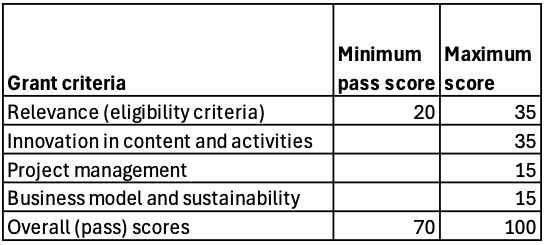
Maximum points: 100 points. Individual thresholds per criterion: Relevance (20 points minimum score). Overall threshold: 70 points. Proposals that pass the overall threshold will be considered for funding. Other proposals will be rejected.
The most important section for the evaluation criteria is the Relevance of the project, this is why this is the only section where we include a minimum pass score. If the projects have less than 20 points in this section, they will not be considered for evaluation because they will not have enough points to reach the overall minimum pass score. The Media Pluralism Fund clearly states that it does not intend to finance the core operations of media organisations but aims to support well-defined projects that go beyond regular activities.
What is understood by innovation?
- A change process aimed at the development of novel services or products, processes within your operations, or the position of your media in the landscape, that enhance the viability of public interest media.
- Agile development: identification of an area for experimentation to find new routes for growth and resilience
- Exploration of applications of new technologies relevant to journalism plurality
- Experimentation with artificial intelligence (AI) solutions in newsrooms and media management
Jury
- The applications are assessed by an independent jury of 4 media experts from Europe. The jury members are chosen by Journalismfund Europe based upon a long list of names suggested by the consortium partners and the international advisory board of Journalismfund Europe.
- The jury decides independently about the granting of the submitted project proposals, based on the grant rules, the assessment criteria and the available budget.
- The jury remains anonymous until all the projects are finalized, to ensure its independent decision-making processes without interference.
- Jury members are bound to Journalismfund Europe's strict conflict of interest policy, which is designed to ensure the highest standards in terms of ethical conduct and to ensure the independence and objectivity of decision making.
PM4D Capacity Building and Mentorship
International Media Support (IMS) will provide capacity building support to the selected grantees, which will include:
- Needs assessment of each of the grantees based on their application and one-to-one online consultation between an IMS media viability expert and the media outlet
- Impact framework to assist partners in planning and implementing their project efficiently and to maximise their project’s impact on target audiences and media outlets
- Practice-oriented webinars tailored to partners’ needs and led by expert media consultants, researchers and practitioners possessing knowledge and experience relevant for small- and medium-sized media outlets. The topics will be finalised after the needs assessment but will centre around the following themes:
- Methods for audience research and user needs
- Community engagement and growth
- Developing commitments to DEI
- Analytics data literacy
- New multimedia content formats
- Content distribution strategies
- Marketing and targeting (SEO and SMO)
- Product design and development
- AI use in newsrooms
- Project management
- Impact measurement and evaluation
- Revenue diversification
- Financial planning
- Business and strategy development
- Set of knowledge products, guides and tools
- Individual expert consultations and mentoring
- Knowledge exchanges among the grantees
All the capacity-building support provided will apply a diversity, equity, and inclusion perspective cross-cutting.
Grant Conditions
- The grantees and all other persons/organisations involved in the project shall endorse the principles of the Global Charter of Ethics for Journalists as well as the national codes of ethics that are in force (i.e. Truth & Accuracy, Independence, Fairness and Impartiality, Humanity and Accountability).
- Every grantee signs an Agreement with Journalismfund Europe that states the mutual arrangements and conditions.
- Grants are paid in two instalments: the first (2/3) upon signature of the Agreement, the second (1/3) after completion of the project and submission and approval of the financial report and supporting documents (in this respect please read the Financial Report tab in the budget template carefully).
- Grants are paid in euro. They are only paid out on the bank accounts of the grantees, not via other money transfer services. Any bank charges for international payments are carried by Journalismfund Europe, except for exchange rates.
- Any journalistic product that is the result of the supported project explicitly has to mention the support from Journalismfund Europe.
- Applicants need to consent with Journalismfund Europe’s general grant rules.
More questions?
Consult our FAQ or contact us.